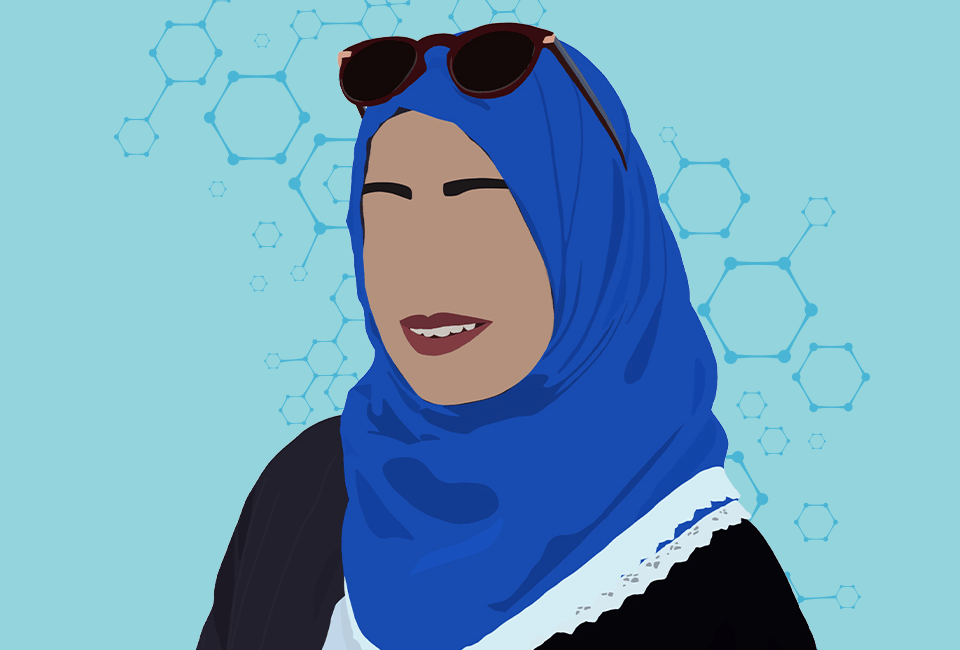
I am Bushra Kanwal and I was born and raised in Karachi. My father was working in Pakistan Navy, so my education started from Naval schools. My father retired after I passed grade 8th examination and decided to move back to our hometown, Bahawalpur. Being raised in a metropolitan city, it was a difficult move for me. The sand dunes in Bahawalpur revoked my childhood asthma and I used to miss my previous school a lot. As I was a position holder since I started school, I had developed an affiliation with the teachers and that school. That first change of my life seemed so big to me that my performance dropped. Somehow, I managed to pass my matriculation from FG Girls Public School and went to Army Public School & College for my Intermediate. Like other South Asian girls, becoming a doctor was my childhood dream, but I scored average grades in the Pre-Medical exams and thus decided to improve on that, prior to appearing for MCAT. As ‘Man proposes, God disposes’, I couldn’t appear in the exams next year due to sickness. I wasn’t used to failures, and the uncertainties of life were making me anxious. I couldn’t make myself lose another year and started seeking admission in the only university of our hometown, because a downing man will even clutch at a straw.
As a first-generation grad student, I had neither the awareness of the admission process nor any clarity about the potential careers. I got to know about the university entrance test (NAT), when it was the last day to apply for NAT-IV (the last test of that year). Considering how things turned out at the end, now it feels like a miraculous year for me, though those days were very hard. With average scores, but brilliant percentile, I managed to get admission in one of the most competitive departments of the university (the only one I applied for, how confident of me!). When there is a will, there is a way. Owing to my father’s service, I availed the reserved quota, but my admission letter was delayed by the nominating headquarters due to uncertain reasons. I was afraid of losing admission and another year. Just one week before the mid-terms, I received the nomination letter, but the wait wasn’t over. The registration required a letter issued directly to the department. Thankfully, I came across the then-chairman and the founder of the department of Biochemistry & Biotechnology, who went out of the way to accommodate me in the department, and I was allowed to attend classes despite of being a non-registered student. Residing in the bubble of uncertainty, I had to appear in the mid-term exams. The letter arrived in the department when I was taking the last exam, thus I got registered after my mid-terms. Unexpectedly, I performed well in the introductory course of biochemistry and biotechnology, taught by the same chairman, and scored second-highest marks in my batch. That raised my low self-esteem and later on, he became a source of inspiration for me due to his scientific achievements and good conduct. Prof. Dr Faiz-ul-Hassan Nasim had received Pride of Performance, a Presidential Award, for his achievements as a molecular biologist, and I learnt from him about dreaming big as a scientist, and thus getting some clarity on my career choices.
I was amongst the very few batchmates to opt Biotechnology as a major for the last two years of my BS(Hons). I was discouraged by many, considering that Biotechnology is still an emerging field in Pakistan with a scarce job market. The trust in Almighty as the provider and ultimate source of sustenance made me stick to my decision and my summer internship at Food & Biotechnology Research Centre (FBRC) in PCSIR Labs Complex, Lahore, realized me that I was right in my choice of interests. Finding out what interests you more, early on, helps you define your career goals; and if you are passionate about something, you will make your place regardless of the scope.
My new goal was to pursue research abroad, but the lack of funds led me start my master’s in biotechnology from the same university. Due to the lack of resources to do a clinical project, I had to choose a ‘Plant biotechnology’ project half-heartedly, as I always had little interest in plants. I still tried to give my best and achieved the first rank in my master’s degree, which gave a boost in my confidence. Whenever I felt like it is difficult to rise again, there came the divine power backing me up to push the boundaries and turned every impossible to possible. Despite the lack of skills required for a clinical project, I ended up in a doctorate journey from the Centre of Stem Cells & Regenerative Medicine at King’s College London.
In the past, I had written a review on biomarkers for Hepatitis B and related diseases as my BS project thesis. At that time, I approached a clinician scientist (Hepatologist) at King’s College London to join his newly established group. He gave a positive response but couldn’t fund an overseas degree (as international student fee was tenfold of a Home student fee). Three years later, I came across the Punjab’s government scholarship, for fully funded PhDs in top ranked 50 universities worldwide, just few days before the deadline. It occurred to me to contact that scientist again and as he agreed to support my application, I managed to submit in time. The proudest moment in my career was to win that scholarship to fund my Doctoral studies at King’s College London, and in a field that has so much potential. That realized me that inconsistent performance is fine, and grades do not define your success. I felt like I have got an opportunity to contribute to the human welfare.
I was very excited about my move and was mentally prepared for cultural transitions but living through these was a different experience. Owing to my different scientific and ethnic background, I had to face discriminatory attitudes. Being a woman in science from a different culture has its own pros and cons. As much as the colleges like our participation to show their diversity, inclusion is not always ensured. Experiencing academia in both the East and the West has further enhanced my exposure, and though, the academic hierarchy found in the East no longer exists in the West, but lack of transparency and patronage is still there. Cultural/gender-based prejudices take the form of microaggression and eventually adds up to disorientate you. But the concerned authorities are always there to listen to your concerns and find a workable solution for you based on particular circumstances.
Women make up over half of the world’s population. However, according to a study conducted by UNESCO’s Institute for Statistics, less than 30% of the world’s researchers are women. So, we need more women to break the stereotypes, as I strongly feel that the solution to gender based prejudice is in our hands. Moreover, I would encourage women to join STEM fields, as it offers interesting challenges and great opportunities to use your creativity and ingenuity. I am much inspired by an Islamic teaching that emphasizes to explore the hidden secrets of life. That inspiration was the reason behind opting a research career in clinical sciences to enhance our understanding of human development and disease.
My aim is to contribute towards finding better cure of diseases in order to improve the quality of life. My PhD research is based on characterising the stem cell niche in liver and finding different protein expression patterns in different liver tumours to find specific treatments for these tumours. Despite working on clinical human samples, I also work on in vitro models of stem cells and liver cells to study the mechanisms. Most of my work involves cell culture, imaging and analysis. As we use coded scripts to run automated analysis in the group, I am also taking courses to self-learn coding. For now, I am mainly focussing to enhance and improve my skill set. In future, I see myself finding the needs of the time and filling the gaps in the field in order to make my ambitions happen.
Bushra Kanwal
Stem Cell & Regenerative